The cage is pretty, too
Some technologies we abandon because they stop working. Others we abandon because they work almost too well, as long as we agree to live exactly as their maker intended. Apple's devices always got things done. My problem was how many decisions I had to hand over to the company so that everything could feel effortless.
I stopped using Apple products in 2015. Nothing dramatic happened; it was a clash of temperaments. I liked computers as places to explore, take apart, understand and occasionally make do something nobody had planned for. Apple seemed to be going the other way, building an environment so tightly knit that leaving it would become a hassle.
I didn't imagine that. In 2014, when Apple introduced OS X Yosemite, it put the integration between Mac and iPhone at the center of the show: Handoff, phone calls on the computer, messages, Instant Hotspot and iCloud. One of its executives argued that only Apple could deliver such an experience because it engineered the platforms, services, and devices together.[1] For plenty of people that was the future, and for me it was the first warning sign on the cage door.
When convenience starts making your choices
I get the appeal. Your headphones talk to your phone, your phone talks to your laptop, photos show up where you expect them, and something you start on one device can be finished on another. It saves time, and I'm not going to pretend it's useless just to prove a point.
The problem is what comes with it. The more your routine relies on little conveniences that only exist inside one ecosystem, the harder it gets to replace a single part of it. Along with the device you buy habits, workflows, services and, little by little, an impressive collection of reasons not to try anything else.
That's what bothers me about the word “convenience”. Often it means somebody else decided which possibilities matter and tucked the rest away behind a pleasant interface. That can be a perfectly good experience, just not the one I want.
Then there's taste, and no data settles that. I've never liked Apple's visual language: the polished surfaces, the choreographed animations, the fixation on looking intuitive, the feeling that every edge was rounded off so nobody would be intimidated. It often strikes me as silly, sometimes even childish. I see the craft. I just don't mistake polish for personality, or visual simplicity for freedom.
I like systems that show signs of use. I want to change something because I can, replace a component, use an odd little utility, write a script, open a terminal and find out why a service failed, instead of being escorted through a rehearsed experience.
The cage isn't completely locked
Not everything Apple makes is equally closed. macOS lets you install applications outside the Mac App Store, and it has a terminal, Unix tools and a lot of third-party software. Apple itself maintains important open-source projects, including Swift and WebKit.[2] Gatekeeper checks signatures and notarization by default, but users can override some of its restrictions in specific circumstances.[3]
Still, Apple has the final say. It defines the platform's essential rules, sets the terms for distributing software and decides which integrations get special treatment. For years that control was especially strong on the iPhone, and competition authorities have challenged Apple's approach to app distribution and payments. In Brazil, the competition regulator CADE approved an agreement with Apple in December 2025; in June 2026, the company announced changes allowing alternative app marketplaces and new payment options on Brazilian iPhones.[4][5] So the walls have shifted, after a regulator stepped in. Apple didn't wake up one day embracing the kind of technological freedom I value.
Security and being treated like a child are different things. I want protection against malware, fraud and mistakes, and I also want the right to take an informed risk with equipment I paid for. Some restrictions are reasonable. What I care about is who gets the final say when a user understands the consequences and wants to take a different route.
The same philosophy shows up in the hardware. For years, independent teardowns and analyses have documented repair difficulties, calibration barriers, and obstacles to replacing components in certain Macs. iFixit’s 2024 teardown of the M4 Pro MacBook Pro offers a concrete example.[6] There has been progress: in 2026, iFixit praised the MacBook Neo’s repairability and improvements in calibrating genuine parts.[7] Repairability is a design decision, and it can improve when somebody decides it matters.
The contradiction I find less amusing than I should
The strangest part is meeting people who speak passionately about open source, decentralization, digital sovereignty and user control, then treat the Apple ecosystem as the natural, unquestionable destination. People who use a Mac for work, battery life, performance or plain preference are fine; nobody should have to pass an ideological purity test before buying a laptop. What I find odd is the passionate defense of freedom of choice that stops at the door of a favorite brand.
Free software, as the GNU Project defines it, means the freedom to run, study, modify and share software, whatever it costs and wherever the code lives.[8] Using proprietary tools doesn't make anyone a hypocrite. But if technological autonomy is central to what you preach, it ought to show up in the decisions you make, or at least in the questions you're willing to ask.
That goes for me too. I use proprietary tools when they solve a problem, and Windows has limitations that deserve no free pass either. I'd rather admit my own compromises than pretend a brand has philosophical virtues because its terminal recognizes familiar commands. I try to reduce dependencies whenever I can: portable file formats, services I can host myself, open protocols, and systems that don't turn migration into a small rescue operation.
Conversations in user communities are often more honest than the usual brand wars. Some people describe leaving the iPhone as liberating; others went back because they missed iMessage, device integration or a familiar routine.[9] Some Linux developers complain about macOS permissions and the ways it interferes with their work, while others admit that a Mac can be reliable and pleasantly predictable for a job.[10]
Then there's Asahi Linux, which has been bringing Linux to Apple silicon. In September 2026, the project announced initial official support for M3 Macs, while making its remaining limitations clear.[11] I admire that effort to expand what a machine can do far more than the claim that a computer is perfect because its manufacturer decided which paths are acceptable.
The MacBook Pro I bought for no good reason
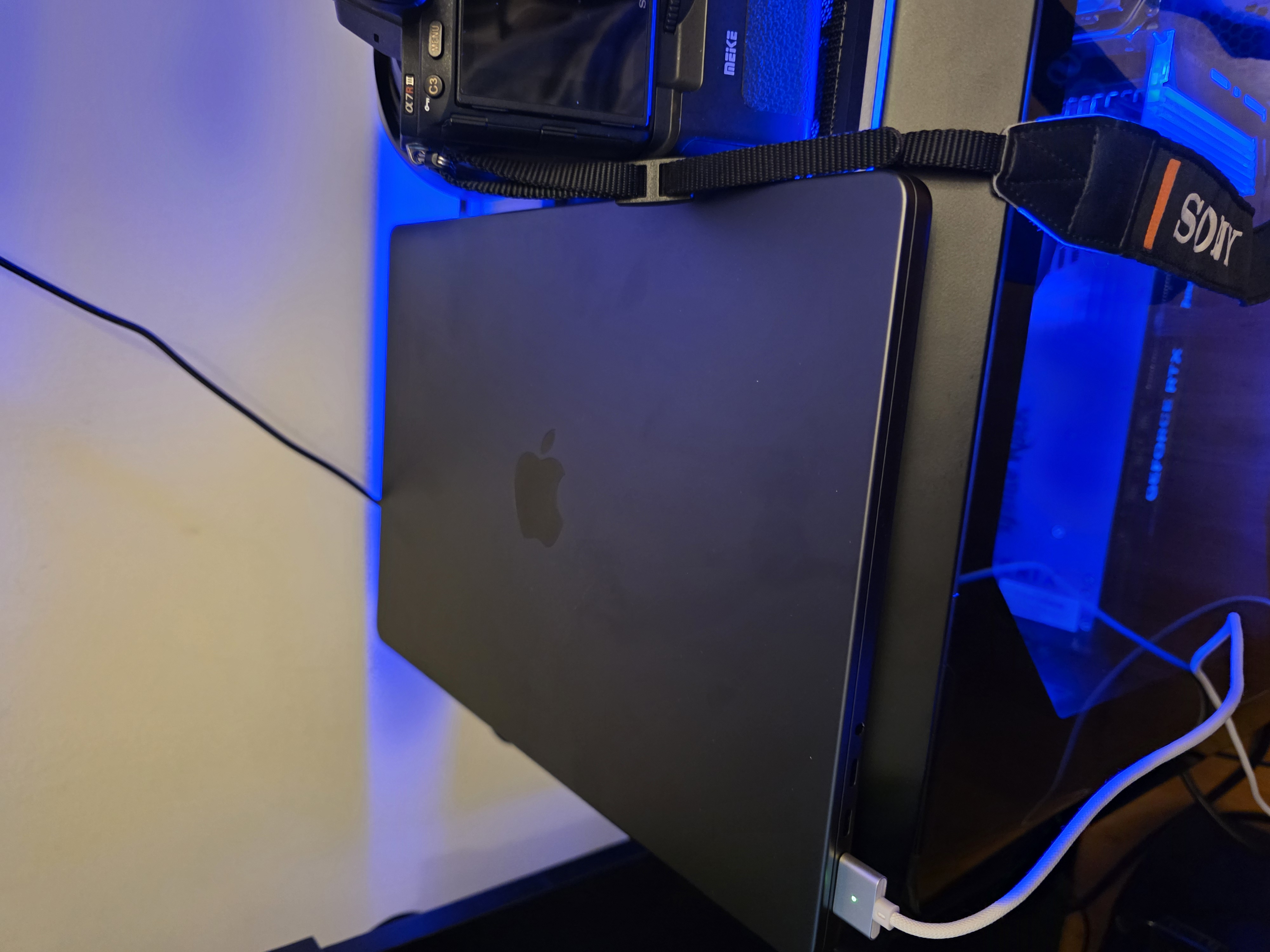
no reason at all
The story doesn't end with me leaving Apple in 2015 and never looking back. What happened is funnier.
Last year, in 2025, I bought a MacBook Pro. I didn't need one, and my other computers were doing their jobs fine. I had an itch to buy one, plain and simple. Call it gadget lust or a momentary lapse in judgment. Maybe it was curiosity, or nostalgia, or the old temptation to buy a beautifully built object and imagine that this time things would be different.
They weren't. It was a good computer, and I had no desire to use it. I kept reaching for another machine, one where I felt more at home and could tinker without feeling like a guest in somebody else's house, where the owner decides where everything belongs.
Eventually I sold the MacBook Pro, without drama and without inventing faults to justify the decision. I was never going to use it, and that confirmed an old suspicion. It took me ten years to run that experiment again.
This isn't about hating Apple
If someone does their best work on a Mac, great. The consistent design, the battery life, the support and the integration are legitimate reasons to love one. My criticism doesn't require everybody to run Linux, compile a kernel or turn their office into a lab.
I don't romanticize inconvenience either. Technological freedom takes work: running your own services, keeping your data portable, making backups and skipping the easy shortcuts is a lot more effort than accepting automatic sync and moving on. I'm interested in that work. I want to understand the technology I use and, when necessary, rebuild it.
It comes down to temperament and principle. I'd rather use a system that sometimes frustrates me but lets me decide than one that delights me at every turn while quietly deciding for me. Apple can be brilliant at engineering and at making products, and I still don't have to admire the philosophy behind them.