Two notebooks: Docs do Murad and Pablo, how?
This blog is where I tell stories. But a lot of what I write never fits a blog post: the exact steps to bring up a server, the script that fixed a certificate, the short explanation of a concept that finally clicked. That writing lives in two other places, and they do different jobs. One is a compendium of recipes in Portuguese. The other is a notebook in English.
Docs do Murad, the recipe shelves #
Docs do Murad is where I record, in Brazilian Portuguese, how I set up and keep running the things I use every day: the VPS, Docker, the servers at home, privacy, websites written by hand. The home page calls it a compendium, a catalog of recipes, and makes a point of saying what it isn't: not a feed and not a garden of drafts.
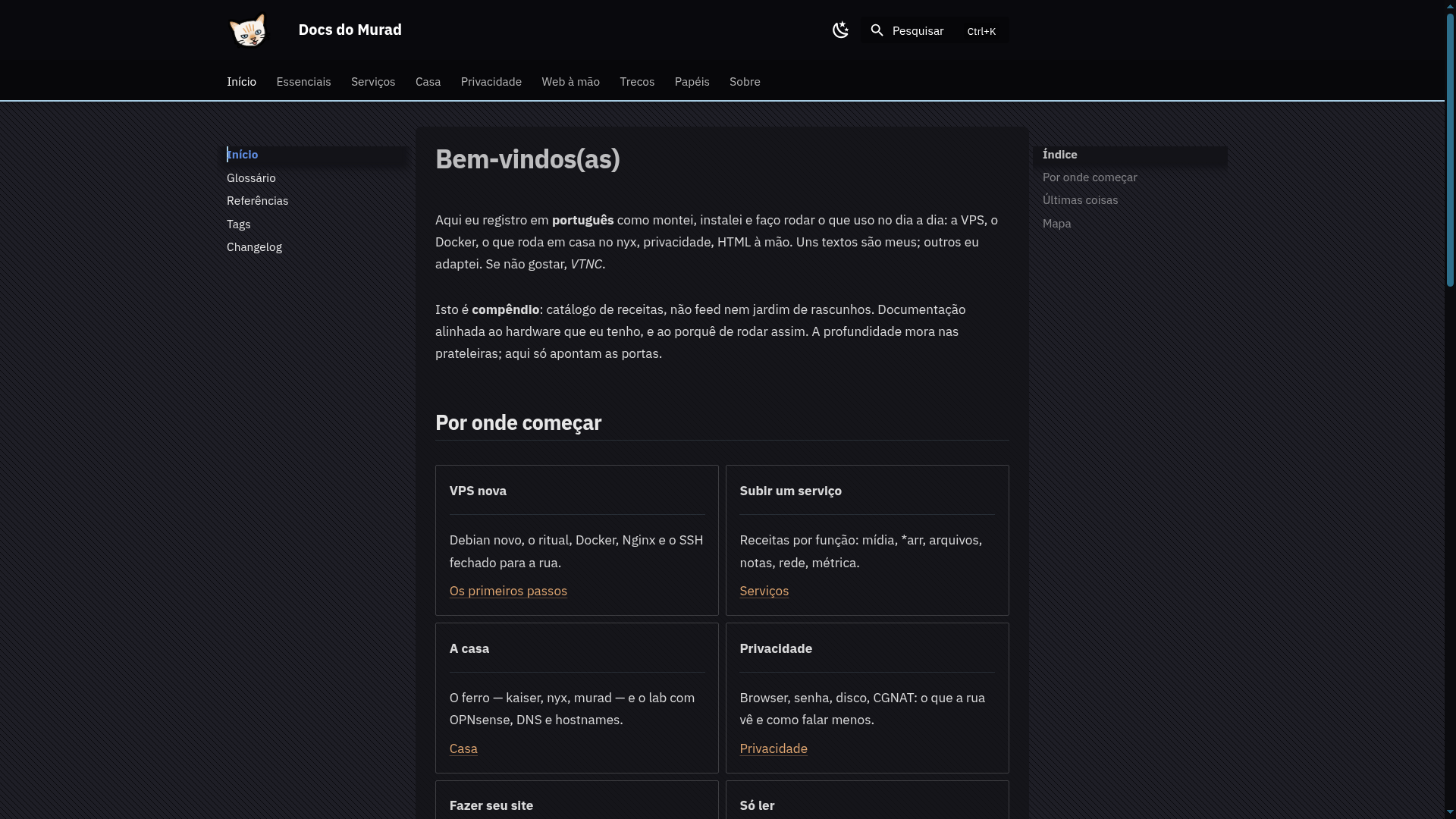
It's organized like a set of shelves:
- Essenciais: the ritual for a new VPS. Fresh Debian, Docker, Nginx and SSH closed to the street.
- Serviços: the biggest shelf, with more than a hundred recipes sorted by what they do (media, files, notes, network, metrics), each marked with the machine it runs on.
- Casa: the hardware at home, the machines called kaiser and nyx, and a lab with OPNsense, DNS and hostnames.
- Privacidade: browsers, passwords, disk encryption, and how to get around CGNAT without depending on the internet provider.
- Web à mão: making a site with plain HTML and CSS, Neocities and the small web, starting from a name and a folder.
- Trecos: the drawer, for everything that doesn't fit anywhere else.
- Papéis: opinion and longer pieces, from BSD to GrapheneOS to the craft itself.
There's also a glossary for words like POSIX, TTY and cgroup, a page of references, an index by tag and a changelog. The changelog describes itself well: not a blog, a log of the shelves. When a page moves to a new shelf, the old address redirects, so links don't break.
The recipes try to be honest about their limits. The first one, about preparing a new server, explains why Debian ("being able to repeat the setup and understand the services that are running weighs more than installing the novelty of the week"), and the certificate script that comes with it lists exactly what it doesn't handle, so nobody runs it blind. Some texts are mine and some are adapted from other writers, with credit on each page.
A few more details. It's built with Zensical and comes to close to 300 Markdown pages. Every page carries tags asking AI crawlers not to train on it. And the site has a mascot, Netuno, a cat who, according to the home page, thinks he has sudo.
Pablo, how?, the notebook #
Pablo, how? is the English side, and a different animal. It's a digital garden: short notes that start small, grow, pick up links to other notes and sometimes get renamed. Nothing there is finished, on purpose.
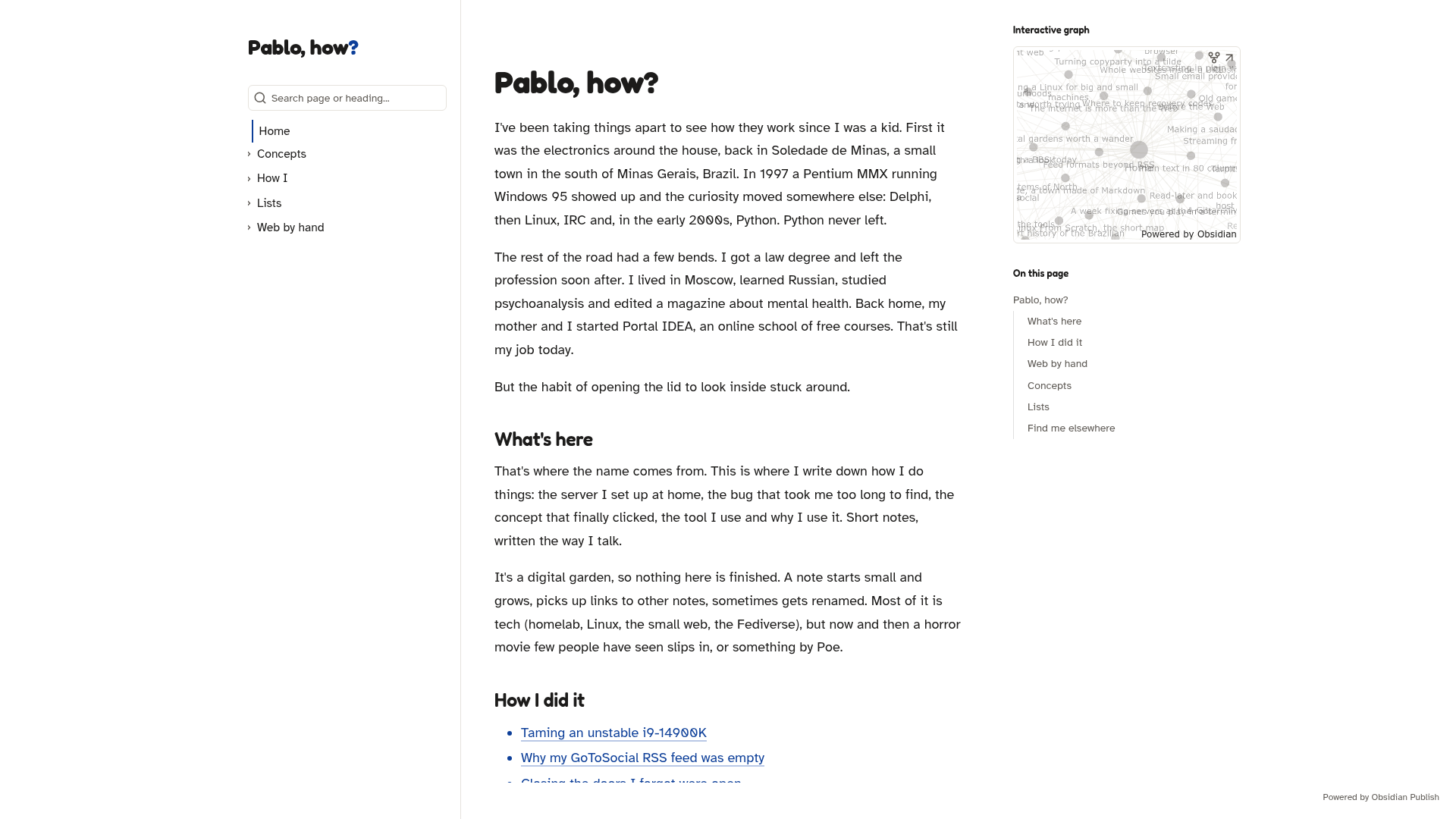
The name comes from the question. It's where I write down how I do things: the server at home, the bug that took too long to find, the concept that finally clicked, the tool I use and why. The home page also tells the long version of how I got here, from the electronics I opened as a kid in Soledade de Minas to the Pentium MMX that showed up in 1997, and from Delphi to Linux, IRC and Python.
The notes come in four kinds:
- How I did it: real fixes, with the mess included. Taming an unstable i9-14900K, finding out why my GoToSocial RSS feed was empty, streaming from behind CGNAT, running a 24/7 TV channel from home.
- Concepts: things explained in plain words. Nostr, IPFS, microformats, LoRa, textcasting, Creative Commons, plus a short history of the Brazilian internet and a look at the operating systems of North Korea.
- Lists: pubnixes worth an account, Gemini capsules worth a visit, games you play in a terminal, small email providers worth paying for, and, because it's my garden, horror films few people have seen.
- Web by hand: a seven-part series that takes a site from an empty folder to a styled page with its own RSS feed, using only HTML and CSS.
It runs on Obsidian Publish, so every page has a small interactive graph of the notes around it, which is a fun way to wander. The Web by hand series even admits it on its first page: "I'm aware of the irony of writing a series about doing it all by hand." There are more than seventy notes so far.
Which one to open #
If you want to do something, step by step, and you read Portuguese, go to the Docs. If you want to understand something, or see how a problem got solved, go to Pablo, how?. And if you want the story around all of it, you're already here.
The garden already links to the Docs, and this blog now links to both. Pick a shelf or a note that looks interesting and follow the links from there.