Chess over the protocols
My first experiments with programming were tiny chess games. That was more than twenty years ago: a board on the screen, pieces that moved when you clicked them, and rules I kept getting wrong. Castling, en passant, the stalemate I forgot existed. Then came chess engines, code that looks at a position and tries to pick a move. Most of mine were bad. I loved every one of them.
I never really stopped. Whenever there's a free weekend and an idea, a chessboard shows up somewhere. Last year alone I think I built three of these experiments. They don't have to be useful. Writing a move generator is a bit like doing a crossword you invented yourself.
So when I started thinking about the next one, I already knew I didn't want to make just another chess game. There are millions of those, and some of them are wonderful. I wanted to answer a different question.
Playing over the protocols #
I spend a lot of my time on the fediverse and on Bluesky. Both are open networks, built on protocols instead of on one company's servers: ActivityPub on one side, the AT Protocol on the other. Anyone can write software that speaks them.
Chess fits that kind of place perfectly. A move is a short piece of text, like e4, Nf3 or O-O. A whole game could happen in replies, the way people used to play by mail, one move a day, in between other conversations.
That left me with a few questions I kept turning over:
- How would someone on Mastodon or GoToSocial play against someone on Bluesky, when the two networks don't talk to each other?
- Who keeps the board? Who checks that a move is legal, and who says whose turn it is?
- What does a game look like in a timeline, without turning everyone's feeds into a chess broadcast?
A bot in the middle #
Where I landed is a bot that lives on both networks at once. On the fediverse it's an ActivityPub account, and on Bluesky it's a regular account too. Underneath, it's the same server holding the same games.
A player mentions the bot and challenges someone, who accepts by replying. From then on every move is a reply in the thread. The bot answers with the new position as an image and tells the other player it's their turn. When the two players are on different networks, the bot carries each move across, so one player can be on the fediverse and the other on Bluesky, and the game doesn't care.
The bot writes the moves down, checks them, keeps the clock for correspondence games and knows when the game is over. The players just play. On Bluesky it answers to @play.chessk.ing, and on the fediverse to @play@chessk.ing.
A project that kept getting parked #
None of this is new in my head. The idea has been around for a long time, and it kept getting parked, one weekend project losing to the next one, or to the work that pays the bills.
This time it moved, and much of that is thanks to the artist Gabriela. With her on board, chessk.ing stopped being a technical experiment with a board in it and started to have a face and a world of its own.
Something of my own #
I could have stopped at the bot. But I wanted something that felt like mine, not a generic board with a generic font.
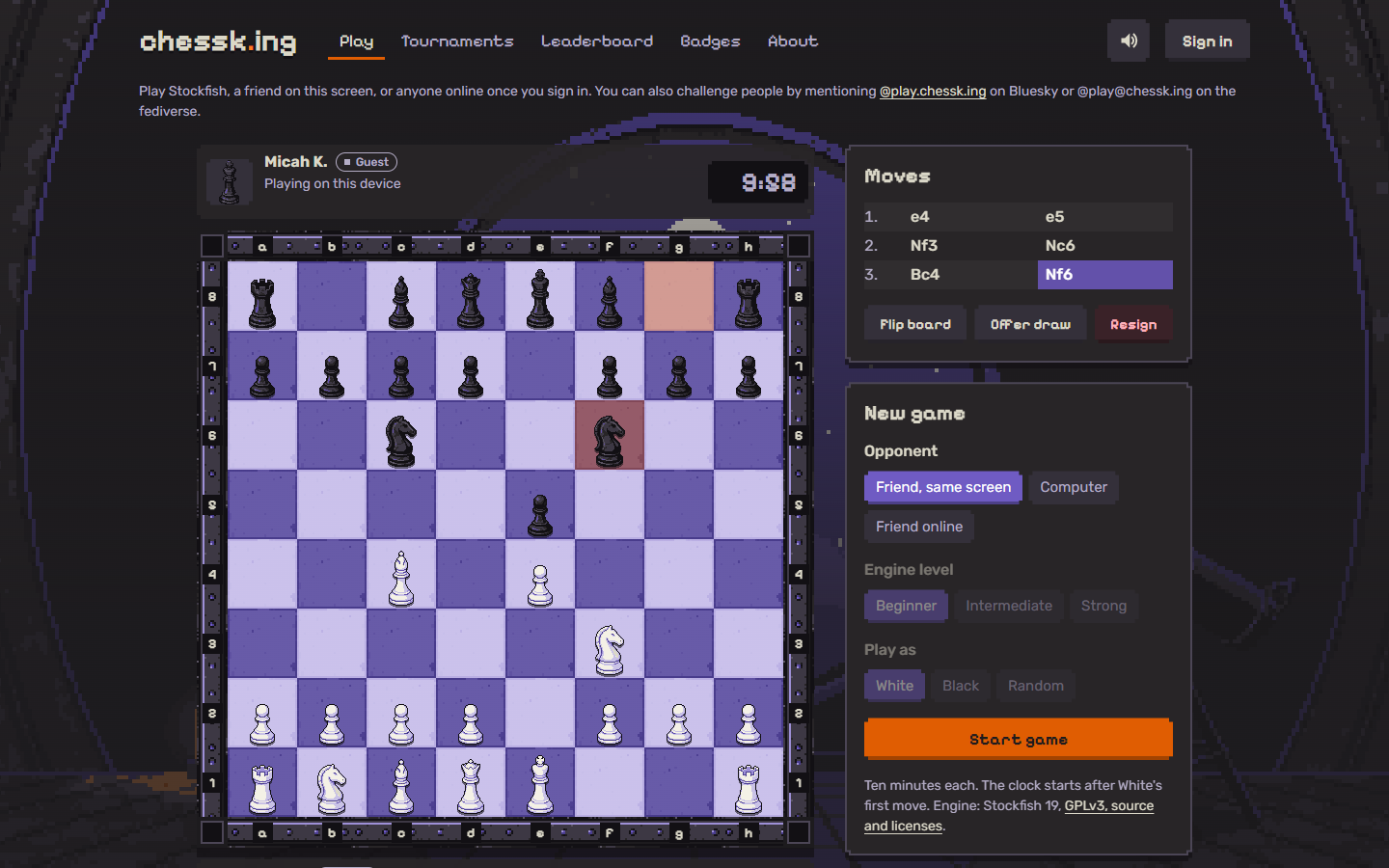
So it grew into a small world. There's a website for live games with a clock, or games against Stockfish at a few levels. There are tournaments, and a monthly leaderboard that also keeps score of the friendly rivalry between the fediverse and Bluesky. There are badges for the silly and the serious things that happen on the board, and stars earned by playing, which buy new looks for the board. The themes are pixel art: an old observatory with a telescope and a moon in the window, a galaxy, a Van Gogh room. Every piece set was drawn for it.
Signing in uses existing accounts, on Bluesky or on any fediverse server. Finished games can also be copied into the player's own Bluesky repository, as records the player owns, and not only as rows in my database.
Privacy was part of the design from the start. Public games are public, discreet games stay out of feeds, and private games are encrypted on the server. Anyone can also stay off the leaderboard entirely.
It's called chessk.ing #
That's the name, and it isn't open yet.
We've already run some test games, and so far everything has been promising. The site stays in "coming soon" mode while I play the first games myself and fix whatever breaks. If everything goes well, maybe it opens in February 2027. I honestly don't know yet, and I'd rather open it late than open it broken.
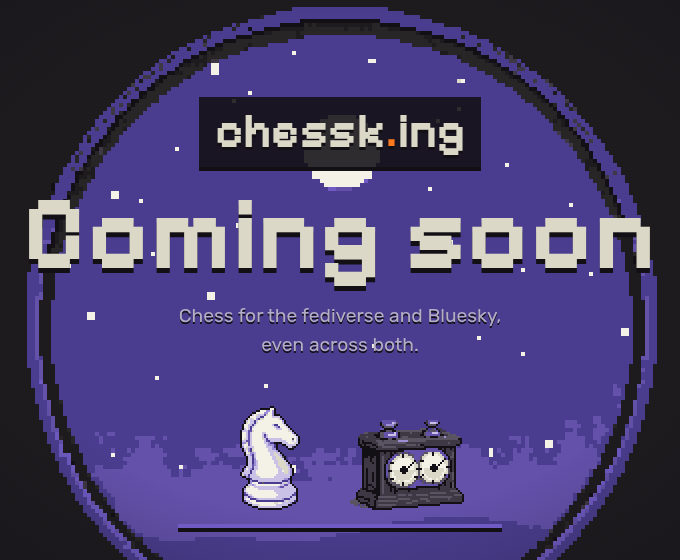
Today chessk.ing has a knight waiting next to a chess clock, under the moon. Mention the bot and it says the same thing: soon.
I'll write again when the board is open. Until then, I'll keep doing what I've done for twenty years: moving pieces around and seeing what happens.